

Happy Canada Day: A Note on Canadian Economic Resilience
Canada Day is a natural time to pause and reflect. Not only on the country we live in, but also on the strength, adaptability, and resilience that have shaped Canada through changing economic cycles.
Over the years, Canadians have faced recessions, inflation, high interest rates, housing pressure, global uncertainty, trade disruptions, market volatility, and rapid changes in how people work and build wealth. And yet, Canada continues to adapt.
That does not mean every household feels financially comfortable. Many Canadians are still dealing with higher costs, mortgage pressure, rent increases, business uncertainty, and the challenge of planning for the future in a changing economy. But resilience does not mean the absence of difficulty.
Resilience means the ability to keep moving forward with discipline, perspective, and a plan. This Canada Day, it is worth remembering that the same principle applies to personal finance, investing, business ownership, and family wealth. Strong outcomes are rarely built in perfect conditions. They are built through preparation, patience, and long-term thinking.
Canada Has Been Through Economic Uncertainty Before
It can feel like today’s challenges are uniquely difficult. Inflation has been a concern. Interest rates have changed quickly. Housing affordability remains a major issue. Businesses are navigating cost pressure, technology disruption, labour challenges, and global trade uncertainty. But uncertainty itself is not new.
Canada has faced many economic tests over time, including:
- Recessions
- Commodity cycles
- Banking stress
- Global conflicts
- Pandemics
- Inflationary periods
- Housing market shifts
- Currency volatility
- Changing trade relationships
- Technological disruption
Each period creates real challenges. But each also reinforces the value of planning. For individuals and families, the lesson is not to ignore economic uncertainty. The lesson is to avoid letting uncertainty stop progress altogether.
Resilience Is Not the Same as Optimism
Optimism says, “Everything will be fine.” Resilience says, “We can prepare, adapt, and make thoughtful decisions even when things are not easy.” That distinction matters.
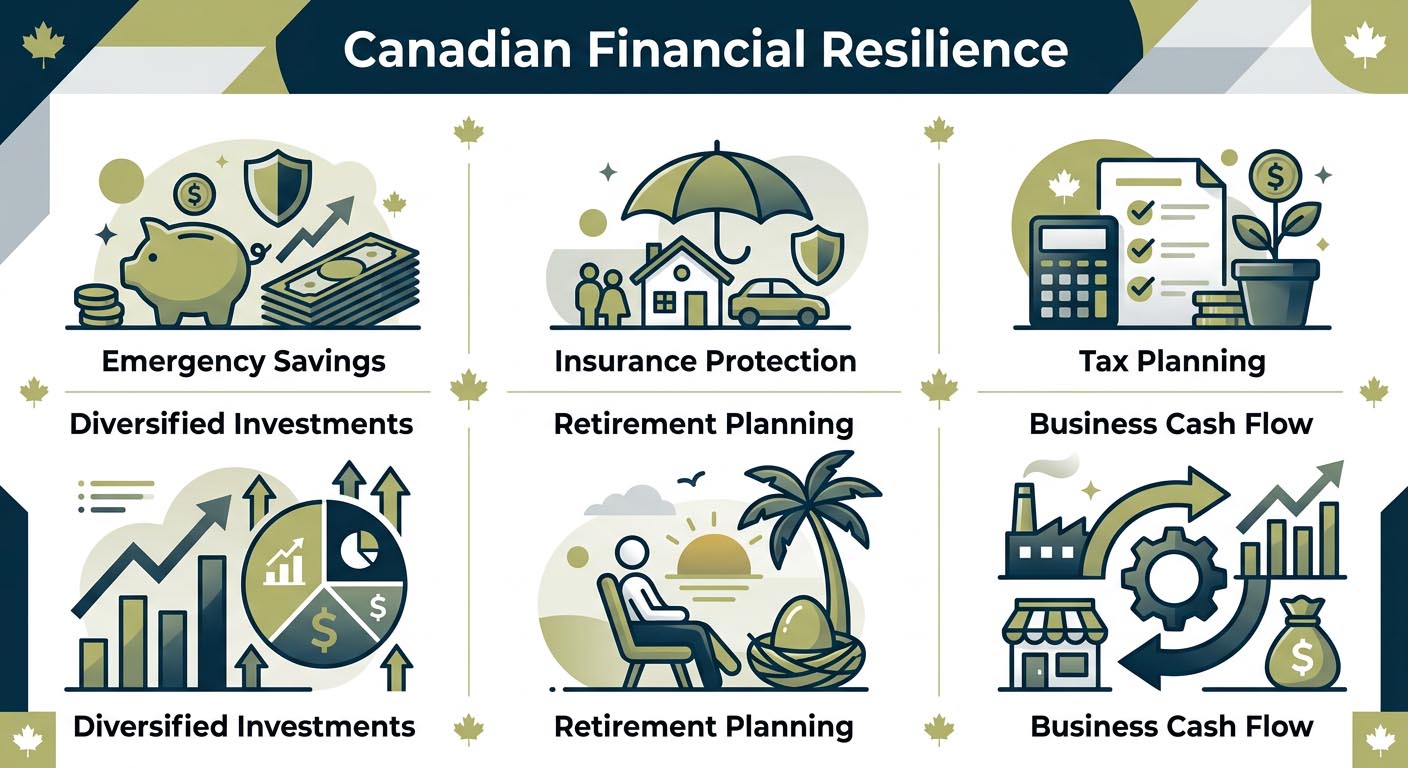
A resilient financial plan does not assume markets always rise, income is always stable, or expenses never change. It accounts for reality. A resilient plan may include:
- Emergency savings
- Insurance protection
- Diversified investments
- Tax planning
- Debt management
- Retirement planning
- Estate planning
- Cash flow awareness
- Business continuity planning
- Regular review and adjustment
The goal is not to predict every challenge. The goal is to build enough flexibility that you are not forced into poor decisions when challenges arrive.
Canadian Households Are Still Feeling Pressure
Even when economic headlines improve, households may still feel stretched. Many Canadians are dealing with:
- Higher grocery costs
- Mortgage renewal pressure
- Rent increases
- Childcare costs
- Debt payments
- Education savings needs
- Retirement uncertainty
- Support for aging parents
- Business income variability
This is why financial planning needs to be personal. A national economic number may show one trend, while a household’s lived experience feels very different.
For example, inflation may ease from its peak, but prices do not necessarily return to where they were before. Mortgage rates may stabilize, but renewal payments can still be higher than expected. Markets may recover, but families may still feel cautious after volatility.
Good planning connects the big picture to the household picture.
The Canadian Economy Is Built on Adaptability
Canada’s economy is not one single thing. It is shaped by many sectors, regions, industries, and communities.
Energy, finance, real estate, technology, agriculture, manufacturing, healthcare, education, natural resources, small business, immigration, exports, and consumer spending all play a role.
That diversity is part of the country’s resilience. When one sector slows, another may strengthen. When one region faces pressure, another may benefit from different economic conditions. When one generation faces new challenges, another may adapt through education, entrepreneurship, migration, technology, or new ways of working. This does not eliminate risk. But it does create a broader foundation.
For investors and business owners, this is a useful reminder: concentration creates vulnerability. Diversification creates flexibility. That applies to portfolios, income sources, business strategy, and family wealth.

Long-Term Thinking Matters More Than Short-Term Noise
Economic headlines can change quickly. One month, the focus is inflation. The next, it is interest rates. Then housing. Then trade. Then recession risk. Then markets. Then government policy. All of these topics matter. But they should not cause families or business owners to rewrite their financial plan every few weeks. Long-term planning is about staying focused on what can be controlled:
- Saving consistently
- Managing debt carefully
- Investing with discipline
- Protecting income and family
- Planning for taxes
- Reviewing insurance
- Preparing for retirement
- Building business reserves
- Keeping estate plans current
- Avoiding emotional decisions
Canada’s economic story has always included cycles. The goal is not to avoid cycles. The goal is to build a plan that can move through them.
Resilience for Investors Means Staying Disciplined
For investors, economic uncertainty often creates emotional pressure. When headlines are negative, investors may want to move to cash. When markets rise, investors may want to chase performance. When rates change, investors may want to overhaul the entire portfolio.
But successful investing is rarely about reacting the fastest. It is about staying disciplined. A resilient investment strategy should reflect:
- Time horizon
- Risk tolerance
- Income needs
- Tax situation
- Liquidity needs
- Retirement goals
- Diversification
- Rebalancing rules
- Long-term objectives
The best portfolio is not always the one that looks best in one calendar year. It is the one that gives the investor a better chance of staying committed through different market environments.
Resilience for Families Means Protecting the Foundation
For families, financial resilience begins with protection. That includes protecting income, lifestyle, dependants, and long-term goals. A family financial plan may need to consider:
- Life insurance
- Disability protection
- Critical illness coverage
- Emergency savings
- Debt management
- Education savings
- Retirement planning
- Estate planning
- Tax-efficient savings
- Support for aging parents
- Intergenerational wealth transfer
When things are going well, protection planning can be easy to delay. But resilience is built before it is needed. A strong family plan helps reduce the chance that one unexpected event disrupts everything else.
Resilience for Business Owners Means Planning Beyond Revenue
Business owners often feel economic change quickly. Higher borrowing costs, wage pressure, changing customer behaviour, supply chain issues, technology shifts, and tax planning decisions can all affect business cash flow. For incorporated business owners, resilience may include:
- Maintaining cash reserves
- Managing corporate withdrawals carefully
- Separating business and personal finances
- Planning salary and dividends
- Reviewing insurance needs
- Protecting key people
- Keeping debt manageable
- Planning for tax installments
- Preparing for succession
- Diversifying client or revenue concentration
Revenue matters. But cash flow, tax planning, documentation, risk management, and long-term strategy matter too. A resilient business is not only one that grows. It is one that can handle pressure without forcing rushed decisions.
Resilience Also Means Knowing When to Adjust
Long-term planning does not mean never changing course. A resilient plan should be reviewed when life changes. That may include:
- Marriage
- Children
- New home purchase
- Mortgage renewal
- Career change
- Business growth
- Business sale
- Inheritance
- Health change
- Retirement
- Divorce or separation
- Death of a loved one
- Major tax or estate planning changes
The key is to adjust for the right reasons. A plan should change because your life, goals, risks, or needs have changed. Not because a headline created temporary anxiety.
Canada Day Is a Good Time to Reconnect With the Bigger Picture
Canada Day is often about celebration, family, community, and reflection. It can also be a useful reminder that financial planning is not just about numbers. It is about building a life with stability, opportunity, and choice.
For some, that means buying a home.
For others, it means growing a business.
For others, it means helping children or grandchildren.
For others, it means retiring with confidence.
For others, it means protecting family wealth across generations.
The economic backdrop will always change. The planning principles remain steady.
Spend with intention.
Save with consistency.
Invest with discipline.
Protect what matters.
Plan for taxes.
Prepare for uncertainty.
Think long term.
That is financial resilience.
A Canada Day Financial Resilience Checklist
This Canada Day, consider using the holiday as a simple checkpoint. Ask yourself:
- Do we have enough emergency savings?
- Are we carrying high-interest debt?
- Are our investments still aligned with our goals?
- Are we prepared for mortgage renewal or major expenses?
- Are our insurance policies still appropriate?
- Are our wills and powers of attorney up to date?
- Are we planning tax-efficiently?
- Are we saving enough for retirement?
- Are we protecting our family or business properly?
- Are we making financial decisions from a plan or from stress?
You do not need to solve everything at once. But asking the right questions is a good place to start.
Final Thought
Canada’s economy has never been free from challenge. But it has shown an ability to adapt, rebuild, and move forward through changing conditions. That same resilience is what strong financial planning is built on. Not perfection. Not prediction. Preparation.
This Canada Day, we celebrate the strength of the country, the families and businesses that keep it moving, and the long-term planning that helps people build with confidence.
Schwartzman Financial helps individuals, families, and business owners connect wealth management, tax planning, insurance, and long-term financial strategy into one clearer plan.
Happy Canada Day!
Here’s to resilience, clarity, and building for the future.
Commonly Asked Questions
What is Canadian economic resilience?
Canadian economic resilience refers to the ability of Canada’s economy, businesses, households, and financial systems to adapt and recover through changing conditions such as inflation, interest rate shifts, recessions, global uncertainty, and market volatility.
Why is economic resilience important for financial planning?
Economic resilience matters because households and business owners need plans that can handle uncertainty. A resilient financial plan includes emergency savings, insurance, tax planning, diversified investments, debt management, and long-term goals.
How can Canadians build financial resilience?
Canadians can build financial resilience by managing cash flow, reducing high-interest debt, maintaining emergency savings, investing with discipline, protecting income, planning for taxes, and reviewing their financial plan regularly.
Should investors change their plan when the Canadian economy slows?
Not automatically. Economic slowdowns may require review, but investment changes should be based on goals, time horizon, risk tolerance, cash flow, and tax situation. Emotional reactions to short-term headlines can create long-term problems.
What does Canada Day have to do with financial planning?
Canada Day is a natural moment to reflect on long-term resilience, family goals, business planning, and financial preparedness. It can be used as a reminder to review whether your financial plan still supports your life and future.
What should business owners review during uncertain economic periods?
Business owners should review cash reserves, debt, tax installments, payroll obligations, owner compensation, insurance, client concentration, succession planning, and the separation between business and personal finances.
How often should a financial plan be reviewed?
Most people should review their financial plan at least annually, or whenever there is a major life event such as a home purchase, career change, business change, inheritance, marriage, children, retirement, or health change.